Azulejos: Ceramic Tiles
This is the geometry we want
to make of our lives: an intertwining
pattern that knots its way across the tiles,
its intricate spread, how your eye
traces the curves and angles along
walls and floors and ceilings full
of the complexity of enduring,
deep ochre and rose and indigo.
Palm-sized tiles, Handprints.
What is ground, what is figure,
we can't be sure; under a steady gaze,
each reverses into the other. How we travel together,
and apart; towards each other and into two
infinitely different
horizons.
Horizons
infinitely different
and apart, towards each other and into two,
each reverses into the other. How we travel together,
we can't be sure. Under a steady gaze,
what is ground, what is figure?
Palm-sized tiles. Handprints,
deep ochre and rose and indigo.
The complexity of enduring.
Walls and floors and ceilings
trace the curves and angles along
an intricate spread, how your eye
patterns the knots across the tiles.
To make of our lives: an intertwining -
this is the geometry we want.
From MARROW, WILLOW by Maureen Hynes (2011)
Maureen Hynes *!

 Marrow, Willow (2011) is already Maureen's third collection of poems. Her first book Rough Skin (1996) won the League of Canadian Poets' Gerald Lampert Award for Best Book of Poetry and together with her second book Harm's Way (2001), she was shortlisted for the CBC Literary Awards and appeared in various literary journals across Canada (just to mention some awards and honours...). She has been Writer-in-Residence at the University of Prince Edward Island and a judge herself to several poetry contests and awards. And she isn't limited to a Canadian audience: she also won one of Britain's major Poetry Awards, The Petra Kenney Poetry Award, and has given various workshops and readings abroad. Astonishingly, given the fact, as she recalls in the same interview that, when one of her poems were rejected by a campus journal during her undergraduate years, her resolution was: '"That's it, I'm not a poet."'
Not so astonishingly, given her resolution, she first turned to writing fiction when she recovered her creativity later on. Her first published work Letters from China (1981) had been a memoir/travel book of her time as an ESL/EFL teacher in China. Furthermore, she had various stories and (academic) articles published, but: still no poems. Surprisingly, Maureen turned back to poetry in times of trouble and obstacles: writing poetry can feel "like [...] climbing onto a stable and supportive raft in a troubled sea." (MH on BCP). A beautiful explanation that writing poetry means more to Maureen Hynes than shaping beautifully rhyming images and it wouldn't be her if she wrote from a limited personal introspection. In combination with her work as Poetry Editor for the national labour magazine Our Times and having been engaged with various social programmes, she is able to see the big picture and to weave the personal with the political and produce "some magical poems" as M. Travis Lane (PoetryReview, 2011) concludes. Probably, it is her core approach to writing poetry which explains her successfully woven work of art and I would like to end her introduction with another citation and a video of Maureen reading:
"The ability to create art out of language, to shape it, with form, into not just something that's beautiful, but something that also resonates with us emotionally and is taken into the core of our beings and remembered - that is something that feels urgent and compelling to me." (MH on BCP )
*CBP = BlackCoffeePoet: take time to check his blog - he has a very interesting approach to poetry as well.
Poem of the Month - September 2012
"Coming Full Circle" from Contrary by Ruth Roach Pierson
(live at Summerhall during the EdinburghFringeFestival, August 2011,
with humble thanks to Fuji Rademaker for fitting the video)
(live at Summerhall during the EdinburghFringeFestival, August 2011,
with humble thanks to Fuji Rademaker for fitting the video)
Ruth Roach Pierson *1938

Some time has passed since the last poem on this blog. I've always wanted to present Ruth reading live this one poem but I had filmed several poems then and not being a media expert I hesitated. Finally, a very fine friend cut and modified the video and I am finally able to present Ruth, live on stage.
Ruth was with a group of Canadian poets in Scotland and we met by chance at the EdBookFest. She presented me a copy of her latest publication and I was immediately struck by the one poem. Coincidently, it reminded me of a personal episode and I grew curious.
Ruth Roach Pierson actually started late in her life writing and publishing poems. She had been busy teaching as professor at the OISE at the University of Toronto. Though Ruth was born and raised in Seattle, USA, read history at the University of Washington and obtained her PhD at Yale University, she immigrated to Canada with her first fulltime academic position. Until 2001 she taught women's history and feminist studies, offering one of the first women's history courses in Canada. Her teaching also brought her back to Germany where she had lived for a year as an exchange student in 1955/56. In 1997/98 she held a Guest Professorship in Gender Studies at the Ruhruniversität Bochum. She was also vice president to the International Federation for Research in Women's History and published numerous acclaimed academic works and journals.
Poetry wasn't really on her list but the seed has already been planted during her time as an M.A. student at the University of Washington where students were to take one 'elective': Ruth's choice fell on Theodore Roethke's course on Reading Poetry. She was very much impressed then and honoured him belated with a poem in her latest publication ("The Best God-damned Poet in the USA"). But only in 1993 did Ruth start to write poems 'officially' by enrolling in a poetry writing course. It was after her retirement from academe that she also started publishing her work of poetry: in 2002 her first book Where No Window Was and in 2007 Aide-Mémoire which was a finalist for the Governor General's Award in 2008. And lately, her collection Contrary in 2011. In the meantime her praised and prized poems were and are published extensively in anthologies and journals.
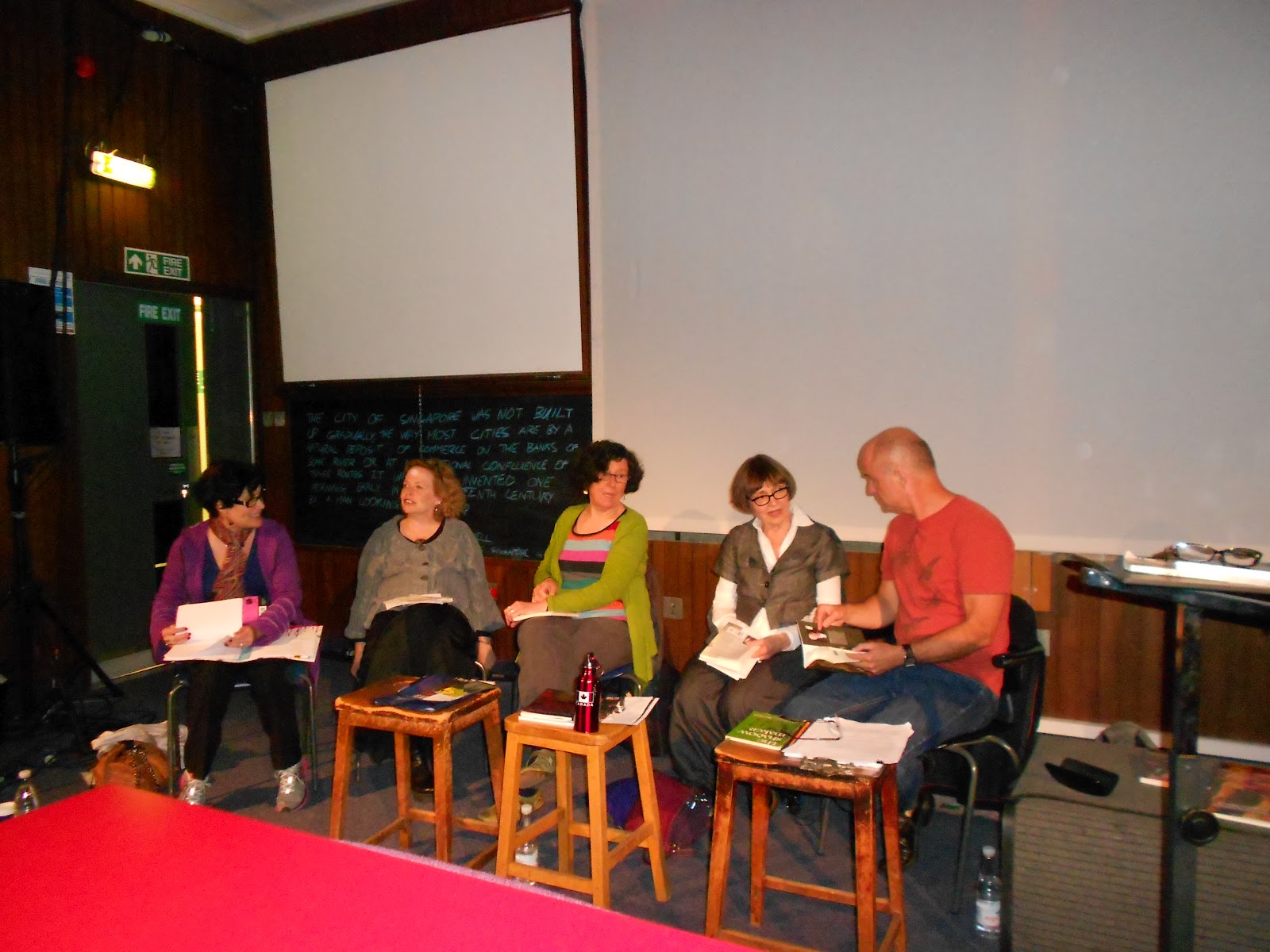 Her style is mainly realistic, reflecting on events and incidents, playing with words and rhythm not so much images and not at all limited to a feminist point of view. I was more than delighted to have met her and her fellow Canadian poets as Jim Nason and Maureen Hynes and happy to have been present at their reading. Especially as Canadian authors, let alone poets, are unfortunately not extensively reviewed in Europe. The more the reason to spread the news...
Quote of the Month - August 2012
"Where there are critical books of immense complexity and learning, dealing, but often at second or thirdhand, with original work - novels, plays, stories. The people who write these books form a stratum in universities across the world - they are an international phenomenon, the top layer of literary academia. Their lives are spent in criticising, and in criticising each other's criticism. They at least regard this activity as more important than the original work. It is possible for literary students to spend more time reading criticism and criticism of criticism than they spend reading poetry, novels, biography, stories. A great many people regard this state of affairs as quite normal, and not sad and ridiculous..."
From the Preface of The Golden Notebook by Doris Lessing (1971)
From the Preface of The Golden Notebook by Doris Lessing (1971)

Quote of the Month - July 2012
"I a-m g-o-i-n-g h-o-m-e. The keys of the typewriter she writes on have already been rubbed smooth, the individual letters can scarcely be distinguished from one another. It is still the same typewriter she brought with her on that odyssey from Berlin to Prague, from Prague to Moscow, and then from Moscow to Ufa in Bashkiria, and near the end of the war, when her son could already speak Russian fluently, back again to Moscow and finally, Berlin. She carried the typewriter in her hand through many streets of many cities, held it on her lap in overcrowded trains, gripping its handle tightly when in this or that foreign place, alone on an airfield or at a train station, she didn't know where to go, when she'd lost her husband in the throng, or else his duties took him elsewhere and he'd boarded a different train. This typewriter was her wall when the corner of a blanket on a floor was her home, with this typewriter she had typed all the words that were to transform the German babarians back into human beings and her homeland back into a homeland."
From Visitation by Jenny Erpenbeck
From Visitation by Jenny Erpenbeck
Jenny Erpenbeck (*1967)

Another female writer who read at the EdBookFest - Jenny Erpenbeck, born in East-Berlin, former German Democratic Republic. And she, too, comes from a family of writers: her grandfather Fritz Erpenbeck was an actor, author and founder of the journal Theater der Zeit. His wife Hedda Zinner was a former actress who turned to politics becoming a left-wing journalist. During WWII they emigrated to Vienna and Prague, moving on to the Soviet-Union in 1935, returning to East-Berlin after the war. Jenny's father John Erpenbeck, born in Ufa, Russia, is a physicist and author and her mother Doris Kilias was a translator of Arabic literature (e.g. Nobel Prize winner Naguib Mahfouz). Nevertheless, Jenny first learned the trade of a bookbinder before turning to the theatre. She started at the Humboldt University of Berlin, changed to study Music Theatre Director at the Hanns Eisler Music Conservatory and completed her studies in 1994. As a freelance director she directed at various opera houses in Germany and Austria. About that time she started also to write. Her first very surreal novel The Old Child gained her all attention right away. Her second novel The Book of Words turned out even more surreal and dreamlike. Her absurd style had Michel Faber write in a review: "[Jenny] is one of the finest,  most exciting authors alive" (The Guardian, 30/10/2012). And it was Michel himself interviewing Jenny at the EdBookFest. Her third novel Visitation was the focus of the evening - another enigmatic novel with a (haunted?!) house as a framing character, its changes of ownership mirroring the political transitions spanning several decennials. "When you come from the East, when you've seen your country disappear, you understand how quickly things can change. Suddenly, everything seems surrealistic!" (EdBookFest, 2011). As the former GDR with its dark secrets 'haunts' her first two books, her third novel is set on a bigger canvas - eventually, the change of the GDR becomes only one of various transitions. Seemingly, those changes and their accompanying losses are 'haunting' Jenny herself. Her fourth novel bears the title: Things that Disappear...
 most exciting authors alive" (The Guardian, 30/10/2012). And it was Michel himself interviewing Jenny at the EdBookFest. Her third novel Visitation was the focus of the evening - another enigmatic novel with a (haunted?!) house as a framing character, its changes of ownership mirroring the political transitions spanning several decennials. "When you come from the East, when you've seen your country disappear, you understand how quickly things can change. Suddenly, everything seems surrealistic!" (EdBookFest, 2011). As the former GDR with its dark secrets 'haunts' her first two books, her third novel is set on a bigger canvas - eventually, the change of the GDR becomes only one of various transitions. Seemingly, those changes and their accompanying losses are 'haunting' Jenny herself. Her fourth novel bears the title: Things that Disappear...
Subscribe to:
Posts (Atom)